Sometimes the way we respond to difficult situations isn’t really about what’s happening in the moment.
Maybe someone gives you constructive criticism, and you immediately become defensive.
Maybe someone hurts your feelings, but instead of admitting you’re hurt, you become angry.
Maybe you avoid a difficult conversation because you tell yourself, “It’s not worth it.”
Maybe you make a joke whenever something gets too uncomfortable.
Or perhaps when life feels overwhelming, you shut down completely and distance yourself from everyone around you.
These reactions can sometimes leave us wondering, “Why do I do this?”
The truth is, many of these responses can be connected to something called defense mechanisms.
Defense mechanisms aren’t necessarily bad. In fact, they often develop for a reason. They are ways our minds try to protect us from emotional discomfort, fear, rejection, shame, pain, or experiences that feel too overwhelming to process.
The problem isn’t always having defenses.
The problem is when those defenses become our automatic way of dealing with everything.
Learning to recognize them can give us an opportunity to move from simply protecting ourselves to coping in healthier ways.
What Are Defense Mechanisms?
Defense mechanisms are psychological strategies we may use—often unconsciously—to protect ourselves from uncomfortable emotions, thoughts, or situations.
They’re essentially our mind’s way of saying:
“This feels like too much right now. Let’s find a way to make it hurt less.”
Sometimes that protection is useful.
If you’re experiencing something overwhelming, temporarily stepping away can give you the space you need to calm down and think clearly.
But defenses can also become habits.
Something that once helped you get through a difficult situation may eventually interfere with your relationships, emotional well-being, or ability to process what you’re actually feeling.
That’s why understanding defense mechanisms isn’t about judging yourself.
It’s about becoming curious.
Instead of asking:
“What’s wrong with me?”
You can begin asking:
“What is this reaction trying to protect me from?”
That question can change everything.
Why Do We Develop Defense Mechanisms?
Our coping patterns don’t appear out of nowhere.
We learn ways of responding to the world based on our experiences, relationships, environment, and what we’ve had to navigate throughout our lives.
If expressing anger was punished, you might learn to suppress it.
If showing vulnerability resulted in rejection, you might learn not to let people get too close.
If admitting you were struggling wasn’t safe, you might learn to say, “I’m fine,” even when you’re anything but fine.
If mistakes were heavily criticized, you might develop perfectionistic tendencies or become extremely defensive when someone points out an error.
Our brains are constantly trying to figure out how to keep us safe.
And sometimes, they learn lessons that sound like:
Don’t trust people.
Don’t show weakness.
Don’t ask for help.
Don’t let anyone see you’re hurting.
Stay in control.
Leave before they can leave you.
Pretend it doesn’t bother you.
These strategies may have made sense at one point.
But something that protected you in the past isn’t necessarily something you need forever.
Common Defense Mechanisms
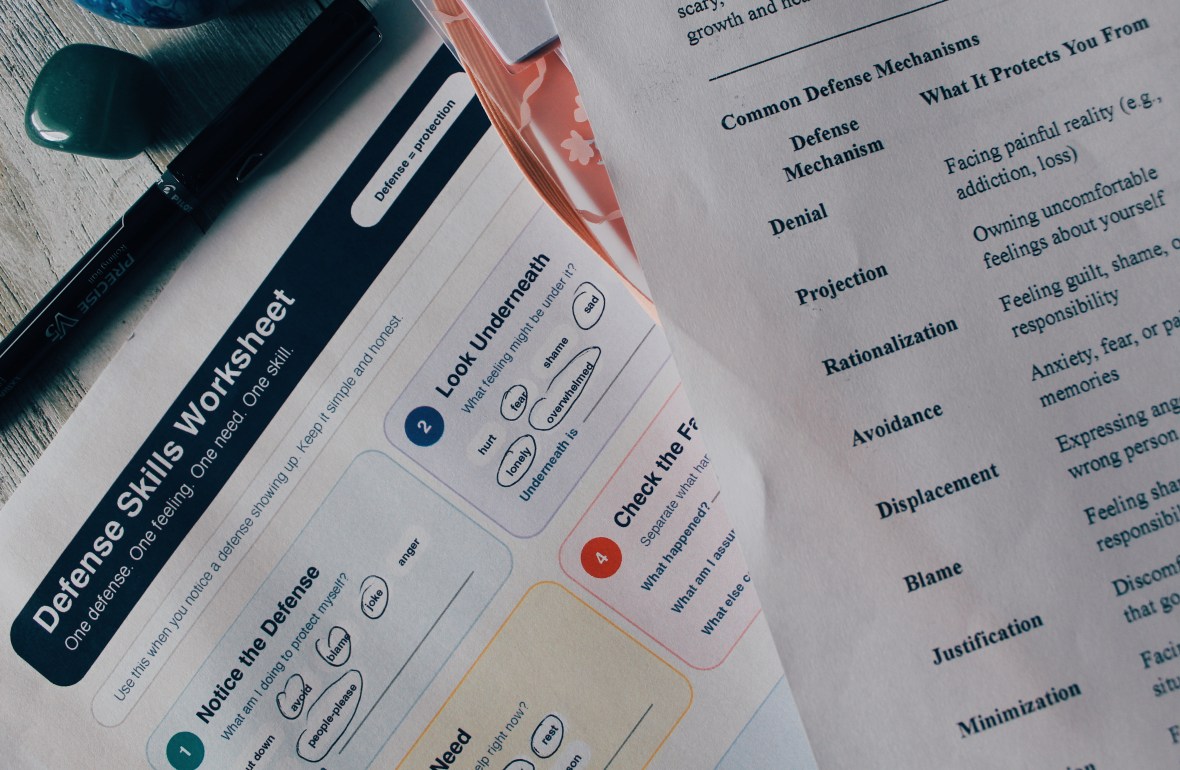
Defense mechanisms can look very different from person to person. Sometimes they’re obvious. Other times, they’re so familiar that we don’t even recognize them as defenses.
Denial
Denial involves refusing to acknowledge something that feels too painful, threatening, or difficult to accept.
You might minimize what’s happening or convince yourself that everything is fine when it isn’t.
“It’s not that bad.”
“I’m overreacting.”
“It doesn’t really bother me.”
Denial can give us time to process something gradually. But staying in denial can also prevent us from addressing problems that need attention.
Avoidance
Avoidance is one of the easiest defenses to recognize because it can look like simply staying away from something uncomfortable.
You might avoid difficult conversations, certain people, responsibilities, places, or even your own emotions.
Sometimes avoidance feels like relief.
And that’s exactly why it can become a habit.
The problem is that avoiding something doesn’t necessarily make the underlying emotion disappear. Sometimes it simply waits for us.
Projection
Projection happens when we attribute feelings, thoughts, or qualities we don’t want to acknowledge in ourselves to someone else.
For example, someone who feels insecure might assume everyone else is judging them.
Someone who is angry might insist that everyone around them is angry.
Projection doesn’t mean we’re intentionally lying or manipulating someone. It can happen without us realizing it.
Recognizing projection requires a willingness to look inward and ask:
“Could some of what I’m seeing in them actually be something I’m struggling with myself?”
Rationalization
Rationalization involves creating logical explanations for feelings or behaviors that may have a deeper emotional reason.
For example:
“I didn’t really want that job anyway.”
“I don’t care that they didn’t invite me.”
“I stopped talking to them because they were annoying.”
Sometimes those explanations are completely true.
But sometimes there’s another emotion underneath them—hurt, rejection, embarrassment, fear, or disappointment—that feels harder to admit.
Intellectualization
Intellectualization is when we rely heavily on logic and analysis instead of allowing ourselves to experience the emotional side of something.
You might be able to explain exactly why a situation happened while still being completely disconnected from how it made you feel.
Understanding something intellectually doesn’t always mean we’ve processed it emotionally.
Sometimes we know what happened but haven’t allowed ourselves to acknowledge what it did to us.
People-Pleasing
People-pleasing can become a way of protecting ourselves from rejection, conflict, disappointment, or abandonment.
You might constantly prioritize everyone else’s needs while ignoring your own.
You say yes when you want to say no.
You apologize even when you’ve done nothing wrong.
You try to keep everyone happy because conflict feels unbearable.
Being kind and considerate isn’t the problem.
The problem is when keeping everyone else comfortable requires you to continually abandon yourself.
Withdrawal
Sometimes protection looks like disappearing.
When we’re hurt, overwhelmed, or afraid of being rejected, we may isolate ourselves rather than risk being vulnerable.
Withdrawal can provide temporary safety.
But if it becomes our primary response to emotional discomfort, it can leave us feeling increasingly disconnected and alone.
Anger
Anger can sometimes function as a protective emotion.
It can feel easier to be angry than to admit:
“That really hurt me.”
“I’m scared.”
“I feel rejected.”
“I’m embarrassed.”
“I don’t know what to do.”
Anger isn’t inherently bad. It’s an emotion that can tell us something matters.
But sometimes anger becomes the armor we put around more vulnerable emotions.
Learning to ask “What’s underneath my anger?” can be incredibly revealing.
When Protection Becomes a Problem
Defense mechanisms become problematic when they prevent us from dealing with what we’re actually experiencing.
Avoiding one difficult conversation might give you time to calm down.
Avoiding every difficult conversation can make it impossible to build healthy relationships.
Taking some time alone after being hurt can help you regulate.
Completely shutting everyone out whenever you’re upset can create loneliness.
Using humor to lighten an uncomfortable moment can be healthy.
Using humor every time something painful comes up can make it difficult to acknowledge what you’re actually feeling.
The question isn’t necessarily:
“Do I have defense mechanisms?”
We all have ways of protecting ourselves.
A better question is:
“Are my defenses helping me or keeping me stuck?”
Recognizing Your Own Defense Mechanisms
Self-awareness doesn’t mean catching yourself doing something and immediately criticizing yourself for it.
Instead, try approaching your reactions with curiosity.
Pay attention to moments when your emotional response feels particularly strong.
Ask yourself:
- What happened?
- What did I feel immediately?
- What did I do next?
- What emotion was underneath my first reaction?
- Was I trying to avoid something?
- Was I trying to protect myself?
- What was I afraid might happen?
- Is this reaction helping me now?
- Is there another way I could respond?
Sometimes simply creating a few seconds between the emotion and the reaction can make a huge difference.
Instead of immediately sending the angry text, take a breath.
Instead of automatically saying “I’m fine,” pause and ask yourself whether you actually are.
Instead of assuming someone is upset with you, consider asking them.
Instead of immediately withdrawing, tell someone:
“I’m overwhelmed right now, but I don’t want to shut you out. I just need some time.”
That is a completely different kind of coping.
From Defending Ourselves to Coping
Healthy coping doesn’t mean that we’ll never become defensive again.
It means we’re learning to recognize our patterns and create more choices for how we respond.
Instead of avoidance, we can practice gradual confrontation of difficult situations.
Instead of suppressing emotions, we can practice naming them.
Instead of people-pleasing, we can practice setting boundaries.
Instead of shutting down, we can practice communicating that we need space.
Instead of reacting with anger, we can practice identifying the vulnerable emotion underneath it.
Instead of pretending everything is fine, we can practice honesty with ourselves and trusted people.
Instead of criticizing ourselves for having these reactions, we can practice self-compassion.
Healthy coping isn’t about becoming perfectly calm, rational, and emotionally balanced all the time.
It’s about having more tools available.
Try Putting the Emotion Into Words
One of the simplest ways to begin moving away from automatic defenses is to name what you’re feeling.
You might simply acknowledge:
“I’m angry.”
“I’m overwhelmed.”
“I’m embarrassed.”
“I’m scared.”
“I’m exhausted.”
“I’m feeling rejected.”
Naming an emotion doesn’t necessarily make it disappear.
But it can make the emotion feel less like an enormous, undefined storm.
Sometimes you discover that anger isn’t actually the primary emotion.
Underneath the anger might be sadness.
Underneath the frustration might be fear.
Underneath the defensiveness might be shame.
Underneath the desire to withdraw might be a fear of being rejected.
When we can identify what’s really happening inside us, we have a better chance of responding to the actual problem rather than automatically reacting to it.
Give Yourself a Pause
You don’t always have to respond immediately.
A pause can be powerful.
Before reacting, try asking:
“What am I feeling right now?”
Then:
“What do I need?”
And finally:
“What response will actually help me?”
That small pause creates space between the trigger and the reaction.
And that space is where change can happen.
Practice Healthier Boundaries
Sometimes our defenses are connected to a lack of boundaries.
We say yes because we’re afraid someone will be disappointed.
We tolerate things we don’t like because we’re afraid of conflict.
We keep giving because we’re afraid that saying no will make someone leave.
Healthy boundaries allow us to protect ourselves without completely shutting people out.
You can say:
“I can’t do that right now.”
“I need some time to think about it.”
“That doesn’t work for me.”
“I’m willing to talk about this, but I don’t want to argue.”
Boundaries aren’t walls.
They’re ways of communicating where we end and someone else begins.
You Don’t Have to Shame the Parts of You That Learned to Survive
Perhaps the most important part of understanding defense mechanisms is recognizing that many of our patterns developed because they served a purpose.
Maybe shutting down helped you get through overwhelming situations.
Maybe making jokes helped you survive uncomfortable moments.
Maybe people-pleasing helped you avoid conflict.
Maybe staying emotionally distant helped you feel safe.
Maybe anger gave you a sense of strength when you felt powerless.
You don’t have to hate those parts of yourself.
You can appreciate what they tried to do while recognizing that you may need different tools now.
There’s a difference between saying:
“This response is terrible, and I need to stop doing it.”
and saying:
“I understand why I learned to respond this way. But I don’t need to rely on it in every situation anymore.”
The second approach leaves room for growth.
Healing Isn’t About Getting Rid of Your Defenses
We may never completely eliminate our defense mechanisms.
And we probably don’t need to.
The goal isn’t to become someone who never protects themselves.
The goal is to become someone who can recognize when protection is necessary—and when it’s preventing connection, growth, or healing.
Sometimes the healthiest response isn’t to push the defense away.
It’s to listen to it.
What are you protecting me from?
What are you afraid will happen?
What do you need me to know?
Those questions can help us understand ourselves in ways that judgment never could.
Final Thoughts
Our defenses are often attempts to protect something vulnerable inside us.
They may not always be the healthiest strategies, but they usually have a story behind them.
Learning to recognize that story can be uncomfortable.
It can also be incredibly freeing.
You can begin noticing the moments when you become defensive, shut down, avoid something, become angry, over-explain, people-please, or tell yourself that you don’t care.
And instead of immediately judging yourself, pause.
Get curious.
Ask what you’re feeling.
Ask what you’re protecting.
Then ask yourself what you need now.
Because the coping strategies that helped you survive yesterday may not be the strategies you need to thrive today.
You don’t have to fight the parts of yourself that learned to protect you. You can understand them, thank them, and slowly teach yourself that you have more choices now.
Related Post: How to Declutter Your Mind
Pin me!













Leave a Comment